Research
Research on spatial intelligence, embodied agents, and 3D scene understanding.
Research trajectory
3D reconstruction and representation relational scene understanding spatial intelligence for embodied agents
I study how intelligent agents can build useful representations of 3D environments, understand objects through their geometric and semantic relationships, and use that spatial knowledge to reason and act.
Research agenda
Three connected questions
Embodied intelligence
Agents that connect perception, reasoning, and action in the physical world.
Spatial intelligence
Representations and reasoning mechanisms for complex 3D environments.
Scene understanding
Semantic and relational interpretation of objects, geometry, and context.
Representative work
Systems and evidence
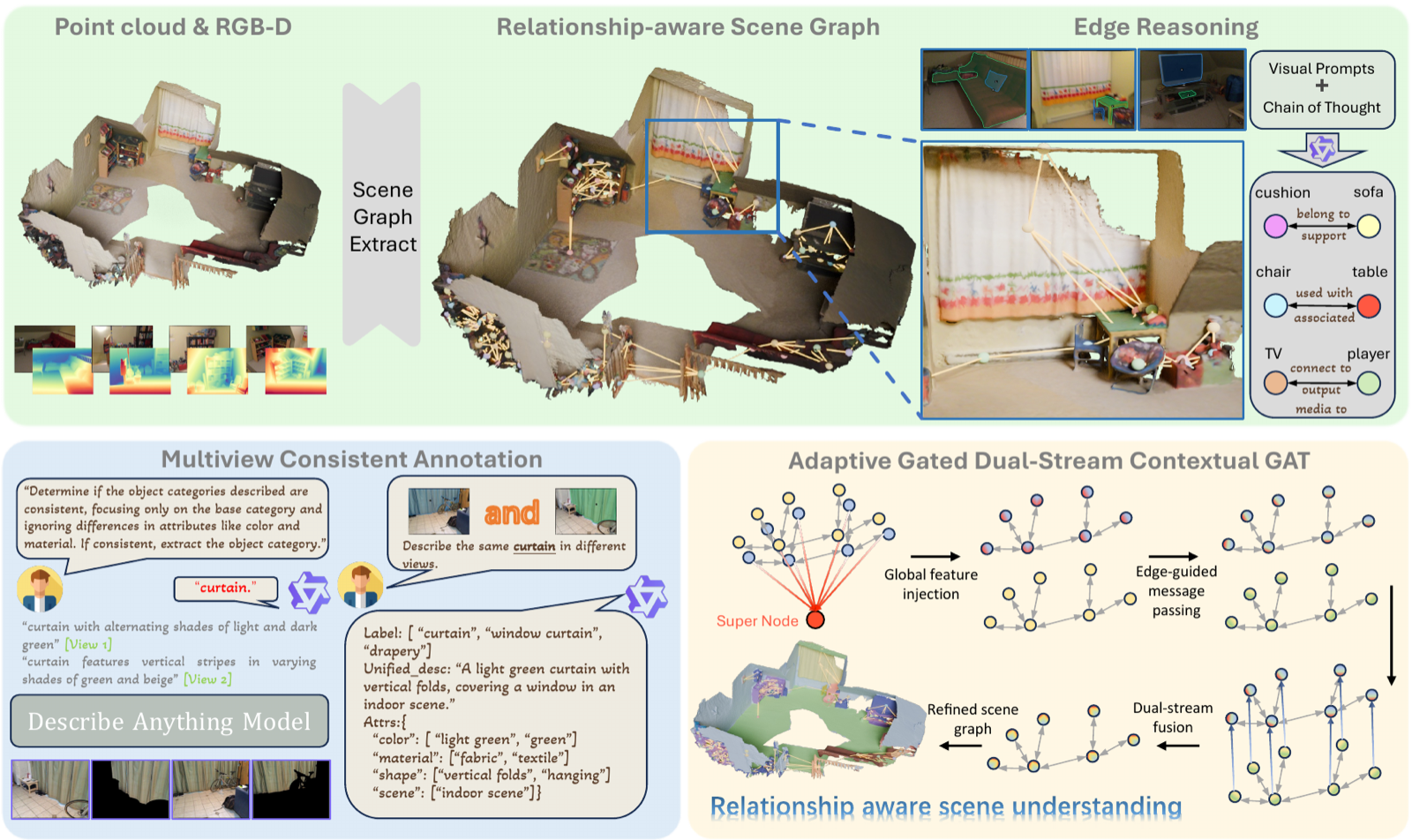
RelGraphOV
Beyond Isolated Objects: Relationship-aware Open-Vocabulary 3D Scene Understanding via 3D Scene Graph Analysis
- Problem
- Open-vocabulary 3D scene understanding often predicts objects independently, leaving visually ambiguous categories without the relational context needed to resolve them.
- Central idea
- Represent a scene as a relationship-aware 3D graph, then combine geometric and contextual evidence through a dual-stream graph network.
- Outcome
- The resulting representation turns isolated object predictions into coherent, relation-aware scene interpretations that are more robust to semantic ambiguity.

CG-SLAM
CG-SLAM: Efficient Dense RGB-D SLAM in a Consistent Uncertainty-aware 3D Gaussian Field
- Problem
- Dense RGB-D SLAM must preserve geometric consistency while keeping tracking and mapping fast enough for practical use.
- Central idea
- Build a consistent uncertainty-aware 3D Gaussian field and use depth uncertainty to select reliable primitives during GPU-accelerated optimization.
- Outcome
- CG-SLAM jointly supports accurate tracking, dense reconstruction, and rendering, with reported tracking speeds of up to 15 Hz.
SamSLAM: A Visual SLAM Based on the Segment Anything Model for Dynamic Environments
ICRCA 2024